
As businesses expand globally, choosing the right payment method becomes vital for controlling costs, speeding up settlements and improving operational efficiency. SWIFT, SEPA and stablecoin payments each offer advantages, but also some limitations and drawbacks. Here’s a breakdown of how they compare and when each option makes the most sense.
How they work
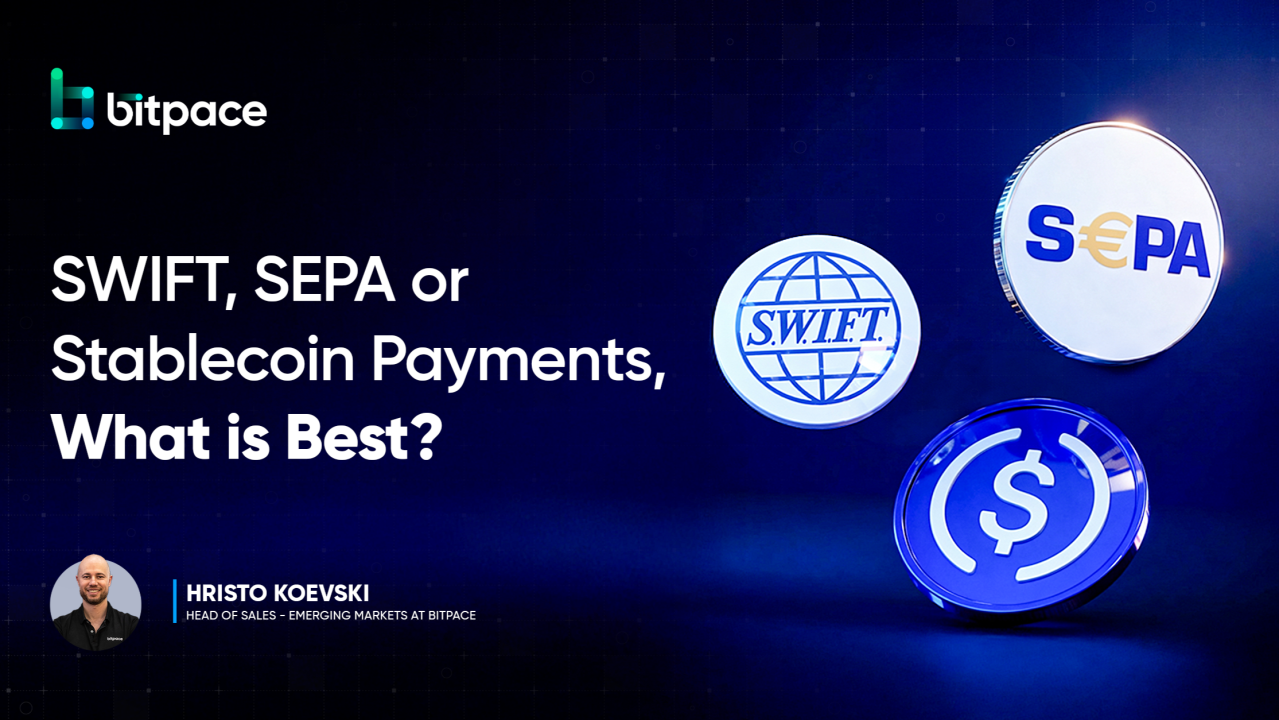
- SWIFT is the traditional global banking network that facilitates international transfers through correspondent banks.
- SEPA standardises euro payments across Europe, creating a unified system for sending and receiving euros.
- Stablecoins are digital assets pegged to fiat currencies, settling over blockchain networks without intermediaries.
Comparing the three payment methods
Speed and efficiency
SWIFT transfers can take a few business days due to multiple banks and cut-off times. SEPA usually completes within one business day, and SEPA Instant operates 24/7. Stablecoins settle in seconds and 24/7, offering the most reliable speed across borders.
Fees and costs
SWIFT fees are often high and unpredictable because of intermediary banks. SEPA is low-cost within Europe, typically free or a small flat fee. Stablecoin transactions are generally cost-efficient, with transparent and predictable network fees.
Security and transparency
SWIFT is secure but lacks real-time visibility which means you don’t know when the payment will be completed. SEPA benefits from EU regulatory standards, with tracking of the status of each payment, but still works through traditional banking infrastructure. Stablecoins offer fully traceable, auditable transactions on-chain, provided businesses use regulated platforms.
Global reach and accessibility
SWIFT is available almost everywhere and has been the industry standard for cross-border payment for decades. SEPA is limited to Europe and euro transfers only. Stablecoins are borderless, accessible to anyone with a compliant digital wallet.
When each method is best
SWIFT still plays a role where partners rely on legacy banking rails or operate in regions with limited digital asset adoption, though the experience is often slower and more expensive. For example, a manufacturer paying suppliers in emerging markets that haven’t yet integrated blockchain infrastructure.
SEPA remains useful for predictable, low-cost euro payments within Europe, but its reach ends at the EU’s borders. For example, a European firm managing payroll or vendor payments across its EU offices.
Stablecoins offer the strongest advantages for most modern businesses, especially those operating across borders. They deliver near-instant settlement, predictable low costs, and full on-chain transparency that traditional rails simply can’t match. For example, a logistics or trading company settling payments across APAC or LATAM in minutes instead of waiting days for banking corridors to clear.
Final thoughts
There’s no single winner among SWIFT, SEPA and stablecoins. They all have a purpose in today’s payment landscape. For companies navigating rapid global operations, combining traditional rails with stablecoin payments can create a faster, more flexible financial strategy. As the financial landscape continues to evolve, businesses that understand how to use a hybrid of systems and leverage their respective strengths will be best positioned for success in the global marketplace.
Bitpace can help you build that hybrid model and unlock smoother cross-border settlement. Let’s talk about how we can get you up and running with stablecoin cross-border payments quickly, securely and with no hassle.